Sabah Nobakhti
Certain moments never fade. Rather they attach themselves somewhere deep in the brain for eternity: a first love with a heart that beats every time a new message appears on the phone screen; a wedding day with the blur of white fabric, music, and hands clapping; a cry of a newborn in a quiet hospital room; a toddler’s first unsteady steps; or an email with the subject line announcing a long-hoped-for job offer —all of those replay with sharp detail even many years after. Other memories linger for different reasons: a dark hospital corridor that smells of antiseptics, a phone call that begins with silence, and weight of the words that divide life into before and after. One of these darker moments for me came on an ordinary workday under fluorescent office lights when I was told that my efforts were no longer needed in the very job that I desperately needed. The chair across the desk, the careful tone repeating those words, and the air growing thick as the sentence landed—those were my last memories from that morning.
In 2010, I arrived in Southampton, England, with two suitcases and a quiet promise to myself that I would make it work. My parents had tucked a stack of savings into my bag before I left, money meant to perhaps help with house renovations, changing the family car, or needs that might come up. Every now and then during the semester another transfer of cash would appear. Although it would barely shift the numbers on the screen, I knew what it had cost them—careful budgeting, postponed purchases, and sacrifices folded into that modest sum. By January 2012, close to graduation time, my account balance could barely cover the weeks ahead. I had imagined a smooth transition: a master’s thesis submitted, PhD offer secured, stipend arriving on schedule—a continuous line for moving forward. But as I sat with my research data spread across my desk, I could see the work wasn’t ready. The paper that could strengthen my PhD application demanded more work, and I needed a few quiet months to shape it into something solid. While planning for months ahead, rent dates circled the calendar. I opened my banking app more often than I wanted to admit, calculating how long I could last. The idea of calling my parents never even crossed my mind. I pictured the savings they had already given up for me and sacrifices they had gone through so far; it was more than enough.
I was caught between my survival and my ambition. Rent day approached, and my bank balance thinned by the day; I needed income, something steady enough to carry me through the year. Yet the thought of clocking into a full-time job and watching my research notes gather dust on the desk tightened my chest. I needed work that would pay the bills without swallowing my hours—a simple, flexible, part-time role. The list of options narrowed quickly. I went online browsing from the list of my limited options. One advertisement promised shifts behind a bar. I ironed my formal shirt and joined a line of confident applicants who spoke easily about their years in local pubs and clubs. Their laughter filled the room; my experience did not. Another listing offered work as a charity fundraiser. The job required knocking on strangers’ doors and asking for donations. We memorized a script dense with persuasive lines and statistics, rehearsing it until the sentences lost their meaning. Each morning, a truck dropped us in a different neighborhood. We moved from house to house, repeating the speech and trying to engage in conversations with locals who had an unfamiliar British tone; doors opened halfway, then closed. We were expected to return with at least three donations each day. I returned with none. On the third afternoon, the supervisor called me aside. His voice remained polite and gentle as he said that their expectations were not met, and then he handed me my first—and last—paycheck.
I then thought, where can I turn my “outsider” status into an asset rather than a liability?! This thought brought me to look at the university’s student portal until a listing for the campus dining hall worker showed up on the screen. The interview was smooth and the supervisor handed me a start date. It was as if a heavy weight was lifted from my shoulders, and I could see hope at the end of the tunnel! I walked to my first shift picturing the ease of it all: no more long commutes, no more cold winds on suburban streets, just the familiar hum of the campus I already called home. I stepped into the kitchen, greeted by the rhythmic clatter of industrial trays and the thick, humid scent of steam tables, convinced I had finally found a sanctuary where I could simply disappear into the work. I was wrong.
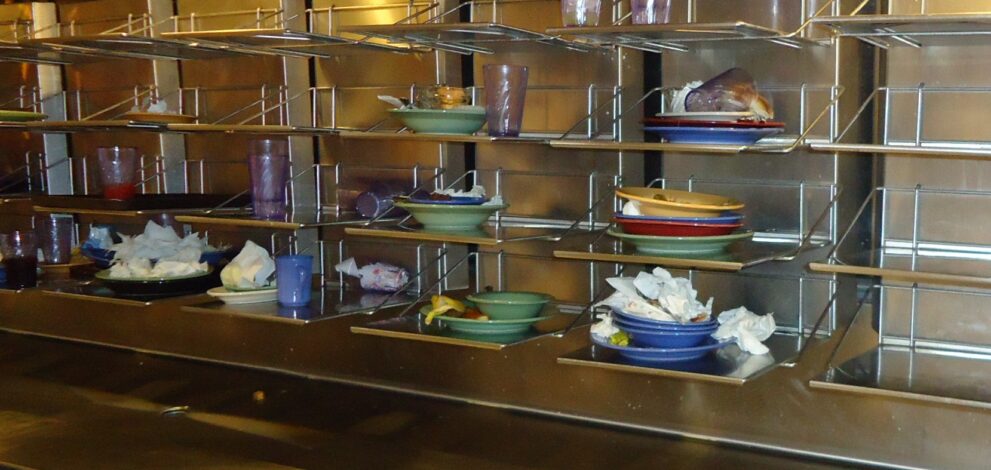
During the day, the conveyor belt of half-eaten meals never slowed. I scraped soggy remains into overflowing bins, my gloves slick with grease as I hoisted heavy plastic racks into the steaming mouth of the industrial washer. Between cycles, I hauled heavy black bags to the dumpsters and then returned to clean the remaining dining tables. I treated each surface like a research project, scrubbing until it fully shined, certain that my meticulousness would be my greatest asset. But in that humid kitchen, the clock was the only judge that mattered. As the end of the shift neared, the kitchen lights hummed over a floor I hadn’t even touched. My manager’s jaw tightened as he snatched the mop from the bucket, the rhythmic, aggressive sound of wet strings against tile signaling a frustration he didn’t need to voice. He wanted the shift over; I wanted it perfect. I watched him finish my work, grounding myself in the hope that this was merely a steep learning curve—a temporary friction before I found my rhythm.
“Move faster,” the manager’s voice would cut through the kitchen steam, a constant, drumbeat against my own rhythm. I looked at the tables—wiped to a mirror finish—and the dishwasher racks—stacked with mathematical precision—and I just couldn’t bridge the gap. To me, the gleaming surfaces were evidence of my dedication, but to them, I was just a slow-moving gear in a machine that demanded speed and efficiency. That unforgettable moment came before the first week could even settle into a routine. The manager’s office was a cramped box with thick air, and both her and my supervisor were present there. I don’t remember the exact script of their dismissal, only the way the sentences seemed to pull the remaining oxygen from the room. An invisible weight pressed down on my lungs, pinning the defense I desperately wanted to voice. I’m doing it right, I wanted to shout. Give me a second to catch my breath. But my throat was tight. The injustice of the moment felt like a physical blow. Why was there no map for improvement? No grace period? I wasn’t a slow person, yet I felt discarded as quickly as the very scraps I had spent all week cleaning.
The silence that followed the dismissal was louder than the industrial kitchen ever was. Questions swirled like a dark tide—What was wrong with me?— each one eroding the confidence I’d spent years building. My energy hadn’t just dipped; it had evaporated, leaving me with a hollow ache in my chest and a tank that had finally run dry. Every step back to my room felt like moving through concrete, my bones heavy with the weight of a future that seemed to be collapsing inward. The numbers in my banking app had stopped moving, frozen at a deficit that meant a month of unpaid rent and a diet cut down to the barest essentials. I sat in the quiet of my room, the pressure of the four walls feeling like they might physically crush me. The “smooth transition” I had envisioned—the PhD, the stipend, the steady climb—was shattered glass at my feet, and I had no tools left to pick up the pieces. The only exit sign left was the one I feared most: a one-way ticket back home. It wasn’t just a return to my parents’ house, it was a surrender to the mandatory conscription that waited for me there, a detour that would swallow years of my life and likely bury my academic dreams for good. I was standing at a dead end, staring at the ruins of every plan I’d ever made.
Despair has a way of narrowing your vision until you can only see the doors that have slammed shut. But as the initial shock of the dismissal faded, I realized I had been trying to force myself into a machine that wasn’t built for me. I was a researcher and an educator, not a “gear.” After a few weeks of sitting with my grief and realization, the air finally cleared when I found a private tutoring job that paid handsomely. Those flexible working hours were a gift, allowing me to finally work on my research and strengthen my PhD applications. Slowly, time acted as a remedy to all the uncertainty and the heavy doubts I’d carried about my own abilities. When I finally had a moment to look back at this experience, I could see that it was all part of a bigger plan—in the end, everything was where it was supposed to be. This turmoil, along with other instances over the past few years, gave me the notion that when life is in a state of chaos, perhaps the best thing is to sit and watch, letting it play by itself. I learned that life does not always play in my favor, and you cannot win every battle. Loss is simply part of it, and the world is not a fair place—not for me, and not for anyone else. We must build on top of what is given to us, in the best shape or form that is possible. The key is acceptance, patience, and moving forward rather than stopping, resisting, and constantly looking backward.
Perhaps no one captures this better than the famous Persian mystic philosopher, “Molana Jalāl al-Dīn Muḥammad” (Rumi), in this poetic adaptation from Book III of his Masnavi:
          This world is like a tree, O noble souls
          And we are the fruit, still green and tart
          The unripe fruit clings fiercely to the bough
          For in its unripeness, it is unready for the feast
          When sweetness peaks in the softness of maturity,
          it lets go of the branch with a gentle grace
          Rigidity and dogmatism are but signs of the unrefined
          For while the soul is an unformed embryo, it leads a vampiric life—
          Consuming the blood of the shadowed womb
          (Until the embryo is born into the sun’s light,
          and that dark subsistence turns to the purity of milk)